
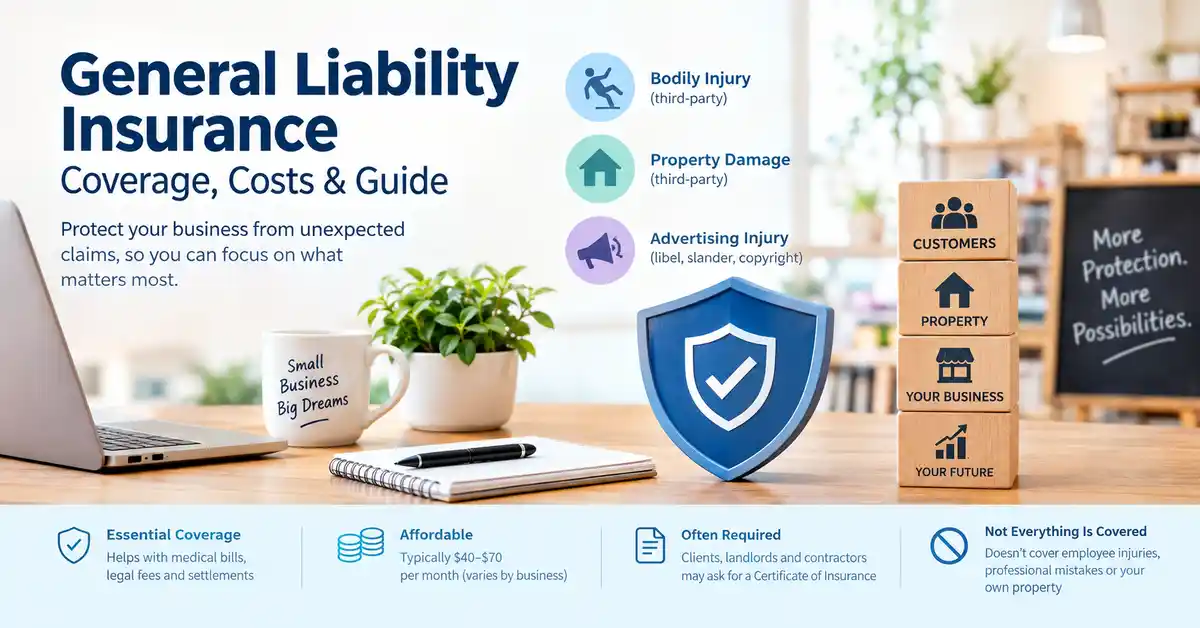
General liability insurance helps protect a business when a customer, visitor, or another third party claims that the business caused an injury, damaged property, or caused certain types of advertising-related harm. If a covered claim leads to a lawsuit, the policy may also help pay legal defense costs and covered settlements or judgments, subject to the policy terms.
For many U.S. small businesses, this coverage is an important starting point. It does not, however, protect against every business risk. The right policy depends on what your business does, where it operates, and the contracts it must meet.
Key Takeaways
- What it covers: General liability insurance can help with covered third-party bodily injury, property damage, and certain personal or advertising injury claims.
- What it costs: Some small businesses may see estimates around $40–$70 per month, but prices vary widely. Treat this range as a rough guide, not a guaranteed quote.
- Proof of insurance: Clients, landlords, and contractors may ask for a Certificate of Insurance (COI) before work begins.
- What it excludes: Employee injuries, professional errors, damage to your own business property, and business vehicle risks usually require other coverage.
- Policy terms matter: Coverage limits, exclusions, endorsements, and the facts of a claim determine whether a policy responds.
What Is General Liability Insurance?
General liability insurance, also known as Commercial General Liability (CGL) insurance, is a business policy designed to address certain claims made by people or organizations outside your business. These claims may involve physical injuries, damage to someone else’s property, or specified personal and advertising injuries.
For example, a customer could trip over an item in your shop, or a contractor working for your business could accidentally damage a client’s property. If the event is covered, the policy may help pay eligible claim expenses and legal defense costs.
Insurers often use standardized policy forms, including forms developed by the Insurance Services Office (ISO). However, policies are not all identical. The insurer, policy wording, exclusions, endorsements, and coverage limits all affect what is protected.
Business Liability Insurance vs. Personal Liability Insurance
Business liability and personal liability insurance are intended for different situations. Homeowners or renters insurance may include personal liability protection for certain incidents in everyday life, but that protection generally does not extend to business activities.
Imagine a visitor slips on your driveway while visiting you socially. Your homeowners policy may respond, depending on its terms. If a paying customer slips in the same area while visiting your home-based business, the business-related circumstances may be excluded from the personal policy.
Whether you operate as a sole proprietor, LLC, or corporation, check that your insurance reflects the activities you actually perform. Your business structure does not, by itself, guarantee that a particular claim will be covered.
What Does General Liability Insurance Cover?
A general liability policy commonly addresses three broad categories of third-party claims. Coverage is always subject to the policy’s definitions, exclusions, limits, and other conditions.
1. Third-Party Bodily Injury
This refers to physical injury to someone outside your business that is connected to your business operations or premises.
Example: A customer slips on a wet floor in your restaurant and is injured. If the claim is covered, general liability insurance may help with eligible medical expenses, legal defense costs, and covered damages.
2. Third-Party Property Damage
A policy may cover certain claims that your business accidentally damages another person’s property.
Example: While mowing a customer’s lawn, a landscaping worker sends a stone through a window. If the incident meets the policy’s terms, the policy may help pay for the covered damage and related claim expenses.
3. Personal and Advertising Injury
Some policies cover specified non-physical claims connected with personal or advertising activities. Depending on the policy wording, examples may include certain claims involving libel, slander, or particular copyright-related offenses in an advertisement.
Example: A business uses a photographer’s image in an advertisement without permission, and the photographer makes a claim. Coverage is not automatic: the policy’s wording, exclusions, and the circumstances of the alleged offense determine whether it may apply.
What Does General Liability Insurance Not Cover?
General liability insurance is not a complete business insurance plan. Other policies may be needed for risks such as:
- Employee injuries: Workers’ compensation insurance is generally designed to address covered work-related employee injuries or illnesses. Legal requirements differ by state and business circumstances.
- Professional errors: Professional liability insurance, often called errors and omissions (E&O) insurance, may help with covered claims alleging that professional services, advice, or work caused a client financial harm.
- Your own business property: General liability generally does not insure your own office, equipment, stock, or furniture against losses such as fire or theft. Commercial property insurance may address these risks.
- Business vehicle risks: Commercial auto insurance is generally used for covered risks involving vehicles used for business.
- Cyber incidents: Cyber liability insurance may help with certain expenses arising from covered data breaches, cyberattacks, or other cyber events.
- Other specialized risks: Depending on your industry, you may need additional policies, endorsements, or higher limits.
Read the policy wording and ask the insurer or a licensed insurance professional about exclusions that may affect your particular business.
How to File a General Liability Insurance Claim
If someone is injured or your business damages another person’s property, take reasonable steps to protect people and document what happened. Follow your insurer’s reporting instructions and any applicable legal requirements.
1. Make Safety the First Priority
Arrange emergency help if someone is seriously injured. Keep people away from hazards when it is safe to do so.
2. Record the Incident
Write down the date, time, location, and a factual description of what happened. If it is safe and appropriate, take photographs of the scene and damage. Record witness contact details where permitted.
3. Keep Communications Factual
Be courteous and cooperative, but avoid guessing about the cause of the incident or making promises about payment. Do not conceal or alter relevant information. Let your insurer guide you on how to respond to a claim.
4. Notify Your Insurer Promptly
Contact your insurance agent, broker, or insurer as soon as reasonably possible and follow the policy’s notice requirements. Share the facts and any documents you have received. The insurer can explain the next steps and investigate the claim.
Optional Coverages and Policy Add-Ons
A basic general liability policy may not meet every business need. Depending on the work you do, you may be able to add an endorsement or purchase a separate policy.
- Cyber liability: May help address specified costs associated with covered data breaches and cyber incidents.
- Liquor liability: May be relevant to businesses that sell or serve alcohol, subject to applicable law and policy terms.
- Inland marine insurance: Can cover certain tools, equipment, or property while in transit or away from the business premises.
- Additional insured endorsement: May extend certain liability protection to a client, landlord, or other party when the policy and endorsement allow it.
- Higher liability limits: Some contracts or higher-risk activities may call for limits above a basic policy’s limits.
These options are not interchangeable, and not every add-on is available or appropriate for every business. Check the exact terms before buying.
Do Freelancers and Independent Contractors Need General Liability Insurance?
Freelancers and independent contractors may benefit from their own coverage, especially when they visit client locations, handle client property, or work under contracts that require insurance.
Being hired by another company does not automatically mean that the company’s policy covers every claim involving an independent contractor. A client may also ask a freelancer to provide a Certificate of Insurance before work begins.
The right policy depends on the services you provide. For example, a contractor who works at customer properties may face different risks from a designer who works remotely. Professionals who give advice or deliver specialized services may also need professional liability coverage.
What Is a Premium Audit in General Liability Insurance?
Some insurers calculate premiums using estimates such as annual revenue, payroll, or other measures of business activity. If the policy is subject to a premium audit, the insurer may compare those estimates with actual figures for the policy period.
If the audited figures show greater exposure than estimated, the insurer may charge an additional premium. If the figures are lower, a credit or refund may be possible under the policy’s rules. The result depends on the policy, the audit, and the insurer’s calculation.
Keep accurate business records and respond to audit requests on time. Ask your insurer what records are required and whether your policy is subject to an audit.
How Much Does General Liability Insurance Cost?
General liability insurance prices vary by business. Industry, location, annual revenue, payroll, employee count, claims history, coverage limits, and the type of work performed can all affect the premium.
Some small-business estimates fall around $40–$70 per month, or approximately $480–$840 per year. This is only a broad illustrative range, not a market-wide guarantee. Some businesses may pay less, while higher-risk businesses may pay substantially more. Obtain current quotes to understand the likely cost for your situation.
A commonly requested limit is $1 million per occurrence and $2 million aggregate. The per-occurrence limit generally applies to a covered occurrence, while the aggregate is the most the insurer will pay for certain covered claims during the applicable policy period. Contract requirements and business risks may call for different limits. Review the policy wording to understand how limits apply.
Factors That Affect General Liability Insurance Costs
- Industry and work type: A roofing contractor may face different injury and property-damage exposures from a graphic designer.
- Business size: Revenue, payroll, staff numbers, and customer traffic can influence the insurer’s assessment of risk.
- Location: Regional claim patterns, legal costs, and other local factors can affect premiums.
- Coverage limits: Higher limits often cost more, although the price difference varies by insurer and business.
- Claims history: Previous claims may affect eligibility or pricing.
- Policy details: Exclusions, endorsements, deductibles where applicable, and the insurer’s underwriting rules can also affect the final quote.
Compare the coverage as well as the price. A lower premium is not necessarily the best value if the policy does not meet your contract requirements or leaves important risks uninsured.
Who Should Consider General Liability Insurance?
This coverage may be useful for businesses that interact with customers, work at client sites, or could cause third-party injury or property damage. Examples include:
- Contractors and tradespeople
- Retail shops
- Restaurants and cafés
- Landscaping and maintenance companies
- Consultants and service providers
- Freelancers and independent contractors
- Small businesses that work at customer locations
General liability insurance is not legally required for every business in every situation. However, a landlord, client, licensing body, or business partner may require it as a condition of a lease or contract.
General Liability vs. Professional Liability Insurance
General liability and professional liability cover different types of claims. Some businesses need both because their work may create physical risks as well as risks connected to professional services.
| Feature | General liability (CGL) | Professional liability (E&O) |
|---|---|---|
| Main purpose | Addresses certain third-party bodily injury, property damage, and personal or advertising injury claims | Addresses certain claims alleging errors, omissions, or problems with professional services |
| Common users | Contractors, retailers, restaurants, and many other businesses | Consultants, accountants, designers, IT professionals, and other service providers |
| Example | A visitor is injured after tripping over equipment at a business location | A client alleges that a professional’s mistake caused financial loss |
| Key limitation | Does not cover every business-related loss | Does not cover every mistake, dispute, or financial loss |
The descriptions above are general. Actual coverage depends on the policy wording and the facts of the claim.
Best Companies for General Liability vs. Professional Liability Insurance
| Insurance company | General liability | Professional liability | Best suited for |
|---|---|---|---|
| NEXT Insurance | Yes | Yes | Small businesses and contractors |
| The Hartford | Yes | Yes | Established small businesses and consultants |
| Hiscox | Yes | Yes | Freelancers and professional service providers |
| biBERK | Yes | Yes | Small and service-based businesses |
| Chubb | Yes | Yes | Businesses needing broader commercial coverage |
These providers offer different business insurance options, but availability and eligibility depend on your industry, location, and business profile.
How to Buy General Liability Insurance Online
Buying a policy online can be straightforward, but take time to check that the coverage matches your work and any contract requirements.
1. Identify Your Business Risks
List the services you provide, where you work, whether customers visit your premises, and whether you handle client property. Review any insurance requirements in your contracts.
2. Prepare Your Business Details
Insurers may ask for your business name, address, industry, estimated revenue, payroll, employee count, and information about your operations. Provide accurate details so the quote reflects your business.
3. Compare Multiple Quotes
Request quotes from more than one insurer or a licensed broker. Compare limits, exclusions, endorsements, payment terms, and the coverage offered—not just the premium.
4. Consider a Business Owner’s Policy
If you also need protection for business property, ask whether a Business Owner’s Policy (BOP) is suitable. A BOP commonly combines general liability and commercial property coverage, but eligibility, included coverages, and pricing vary.
5. Review the Policy and Request a Certificate
Before purchasing, check the policy terms and confirm that the limits satisfy your needs. After coverage is issued, the insurer or broker may provide a Certificate of Insurance (COI) as evidence of coverage. A COI summarizes insurance information; it does not change the policy or add coverage by itself.
Final Thoughts
General liability insurance can help small businesses manage certain third-party claims involving bodily injury, property damage, and specified personal or advertising injury. It may also help with eligible legal defense costs and covered damages.
It is not a substitute for every other type of business insurance. Depending on your work, you may also need workers’ compensation, professional liability, commercial property, commercial auto, cyber, or specialized coverage.
Before choosing a policy, compare quotes and review the limits, exclusions, endorsements, and contract requirements. The most suitable policy is one that fits your actual business risks—not simply the one with the lowest price.
Frequently Asked Questions
1. Does general liability insurance cover employees who get hurt at work?
Generally, no. General liability is primarily designed for certain third-party claims. Workers’ compensation is generally the relevant coverage for covered work-related employee injuries or illnesses, subject to state law and the circumstances.
2. Are general liability insurance premiums tax-deductible?
Business insurance premiums may be deductible when they qualify as ordinary and necessary business expenses under applicable tax rules. Eligibility depends on your circumstances, so consult current IRS guidance or a qualified tax professional for advice about your return.
3. How quickly can I get a Certificate of Insurance?
Some insurers and online brokers provide a digital Certificate of Insurance soon after a policy is issued. Timing varies by provider, application, and underwriting requirements. Confirm when the policy becomes effective and when the certificate will be available.
4. Can I buy general liability insurance online on the same day?
Some providers may allow eligible businesses to complete an online purchase and receive proof of coverage quickly. Approval, payment processing, policy effective dates, and certificate availability vary. Read the policy documents and confirm the effective date before beginning work.
5. Is general liability insurance required by law?
Requirements depend on the business, location, industry, and circumstances. Even when a law does not require the policy, a landlord, client, or contractor may make it a contractual requirement.
Keep Learning:
State Farm Renters Insurance Review 2026: Powerful Benefits, Costs & Drawbacks