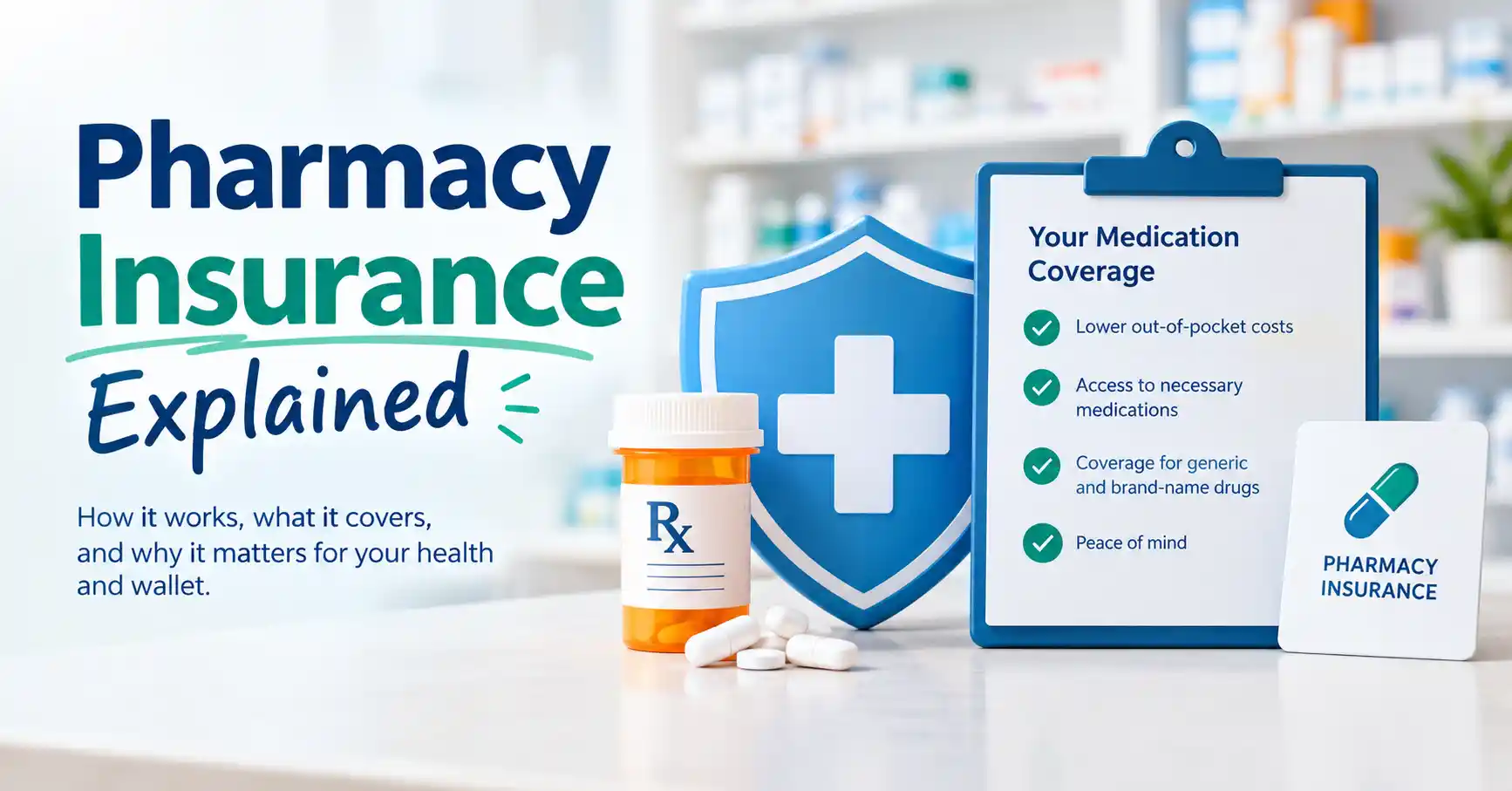
Pharmacy insurance, also known as prescription drug coverage, is a type of health benefit that helps pay for prescription medications. It subsidizes the cost of drugs through a tiered pricing system, requiring you to pay a set copay or percentage of the cost while the insurance covers the rest.
Most Americans receive pharmacy benefits as part of their health insurance plan, although Medicare Part D and some other programs offer separate prescription drug coverage. Your actual cost depends on your plan’s formulary, drug tier, deductible, pharmacy network, and other coverage rules.
1.1 Key Takeaways
- Pharmacy insurance is often bundled with standard medical health insurance, but it operates using different networks and pricing rules.
- Medications are categorized into “tiers” on a list called a formulary; lower tiers (generics) cost less, while higher tiers (specialty drugs) cost more.
- Your pharmacy insurance card contains specific routing numbers (BIN and PCN) that the pharmacist uses to bill your insurance company.
- If you only have Medicare Parts A and B, you must purchase a separate Medicare Part D plan to get pharmacy insurance.
- New for 2026: Medicare Part D out-of-pocket costs are strictly capped at $2,100 per year, and the infamous “donut hole” has been permanently eliminated.
- The Cash-Pay Shift: Because of complex insurance pricing, buying generic drugs for cash through cost-plus pharmacies is now sometimes cheaper than using your insurance copay.
What is Pharmacy Insurance?
Pharmacy insurance is a health plan benefit designed exclusively to help cover the cost of prescription drugs. While medical insurance pays for doctor visits, hospital stays, and surgeries, pharmacy insurance kicks in when you drop off a prescription at a retail pharmacy or order medications through the mail.
In the United States, pharmacy benefits are usually managed by third-party companies known as Pharmacy Benefit Managers (PBMs). PBMs negotiate discounts with drug manufacturers, process claims behind the scenes, and build networks of preferred pharmacies.
How Pharmacy Insurance Coverage Works
To understand your pharmacy insurance coverage, you need to understand two main concepts: the formulary and drug tiers.
The Formulary
A formulary is your insurance plan’s official list of covered medications. If a drug is not on this list, your pharmacy insurance will not pay for it, and you will be responsible for the full retail price.
Drug Tiers
Insurance companies divide the drugs on their formulary into different pricing categories called tiers. The tier dictates your out-of-pocket cost.
| Tier Level | Drug Type | Typical Out-of-Pocket Cost | Example |
| Tier 1 | Preferred Generic | Lowest copay ($5 – $15) | Metformin (generic for Glucophage) |
| Tier 2 | Non-Preferred Generic | Low copay ($15 – $30) | Specific generic formulations |
| Tier 3 | Preferred Brand-Name | Medium copay or coinsurance | Eliquis, Jardiance |
| Tier 4 | Non-Preferred Brand-Name | High copay or coinsurance | Newer brand-name drugs with generic alternatives |
| Tier 5 | Specialty Drugs | Highest cost (often a % of the total price) | Humira, complex biologics |
Note: Copay amounts vary wildly depending on your specific plan design.
Pharmacy Benefit vs. Medical Benefit: A Complete Guide for Patients
Health Insurance (The Medical Benefit)
Your medical benefit is designed for care that is performed on you or for you by a licensed professional in a clinical setting.
- What it covers: Doctor visits, hospital stays, surgeries, and—crucially—medications that must be administered by a healthcare provider. If you need an IV infusion, chemotherapy, or a specialized injection at a clinic, it falls under medical.
- How billing works (“Buy and Bill”): Medical insurance uses a “buy and bill” system. The hospital or doctor buys the medication, treats you, and then submits a complex claim (using procedure codes like HCPCS or “J-codes”) to your insurance.
- The patient experience: Because claims take weeks to process, you rarely pay upfront. You receive an Explanation of Benefits (EOB) and a surprise bill in the mail weeks after your appointment.
Pharmacy Insurance (The Pharmacy Benefit)
Your pharmacy benefit is specifically designed for outpatient prescription drugs that you manage and self-administer at home.
- What it covers: Daily pills, inhalers, self-injected pens (like insulin), and specialty drugs mailed to your house. These are organized into cost “tiers” (like airline seating), where generic drugs are the cheapest (Tier 1) and brand-name or specialty drugs cost the most (Tiers 3 and 4).
- How billing works (Real-Time): Pharmacy billing is lightning-fast. The drugs are tracked using National Drug Codes (NDCs), and the pharmacy system communicates with your Pharmacy Benefit Manager (PBM) in seconds.
- The patient experience: There is no waiting for a bill. You know exactly what your copay or coinsurance is the moment you stand at the pharmacy counter, and you pay it before walking out the door.
The Gray Area: Where They Collide
Because these are two separate systems—often with entirely separate deductibles and out-of-pocket limits—the exact same treatment can be billed differently depending purely on where you get it.
If you get a flu shot during your annual physical at the doctor’s office, it is processed through your medical benefit. If you walk into a retail pharmacy and get that exact same flu shot, it is processed through your pharmacy benefit. Similarly, complex “specialty drugs” for conditions like rheumatoid arthritis or cancer sometimes require careful navigation, as insurers decide whether it’s cheaper to have you inject it at home (pharmacy) or go to an infusion center (medical).
What is a Pharmacy Insurance Card?
When you enroll in a health plan, you receive an ID card. But what is a pharmacy insurance card exactly?
Often, your medical and pharmacy information are printed on the same physical card. However, the pharmacy needs specific codes to process your prescription claim.
When you hand the pharmacist your card, they are looking for four specific numbers:
- Member ID: Your personal identification number.
- Rx BIN (Bank Identification Number): A six-digit number that tells the pharmacy’s computer system which insurance company is paying the claim.
- Rx PCN (Processor Control Number): A secondary routing number that identifies the specific drug benefit package within the insurance company.
- Rx GRP (Group Number): Identifies your specific employer or plan sponsor.
If you have a standalone prescription plan (like Medicare Part D), you will receive a separate, dedicated pharmacy insurance card in the mail.
Type of Pharmacy Insurance in the US
Prescription coverage comes in a few different forms depending on how you get your healthcare:
- Employer-Sponsored Plans: Most workplace health insurance includes bundled pharmacy benefits.
- ACA Marketplace Plans: Under the Affordable Care Act, prescription drug coverage is considered an “Essential Health Benefit.” All plans sold on Healthcare.gov automatically include pharmacy insurance.
- Medicare Part D: Original Medicare (Parts A and B) does not cover retail prescriptions. Seniors must buy a separate Part D plan or a Medicare Advantage (Part C) plan that includes drug coverage.
- Medicaid: State-run Medicaid programs provide pharmacy insurance for low-income individuals, usually with zero or very low copays.
Major 2025–2026 Changes to Medicare Pharmacy Coverage
If you get your pharmacy insurance through Medicare Part D, the landscape has changed dramatically in recent years due to the Inflation Reduction Act. If you are shopping for coverage or currently enrolled, here is how the new rules work:
- The $2,100 Out-of-Pocket Cap: Medicare Part D out-of-pocket spending is now strictly capped. For 2026, the maximum you will pay out-of-pocket for covered medications is $2,100 per year. Once you hit this limit, your plan pays 100% of the cost for covered drugs for the rest of the year.
- The “Donut Hole” is Dead: For years, Medicare patients dreaded the coverage gap known as the donut hole, where out-of-pocket costs temporarily spiked mid-year. This was officially eliminated in 2025 and remains gone.
- Negotiated Drug Prices: Starting in January 2026, Medicare officially lowered the prices on 10 high-cost, brand-name medications (including popular blood thinners and diabetes drugs like Eliquis, Jardiance, and Fiasp).
- Monthly Payment Smoothing: If you face high upfront costs at the pharmacy in January, you no longer have to pay it all at once. The Medicare Prescription Payment Plan allows you to spread your out-of-pocket drug costs into equal monthly installments billed by your health plan.
Comparing the Best Pharmacy Insurance Companies in the US
When US consumers search for the “best pharmacy insurance,” it is important to understand that unless you are buying a standalone Medicare Part D plan, you usually don’t choose your pharmacy insurer directly. Instead, your employer or health plan selects a Pharmacy Benefit Manager (PBM).
The US market is heavily consolidated, with the top three companies controlling approximately 80% of all prescription claims. Here is a comparison of the top pharmacy insurance companies and PBMs, including their pros, cons, and best use cases.
1. CVS Caremark (Aetna)
CVS Caremark is the largest PBM in the United States. Because it is owned by CVS Health (which also owns Aetna health insurance), it offers massive integration between your insurance, your local retail pharmacy, and your MinuteClinic. In recent years, they have also introduced “CVS CostVantage,” a transparent cost-plus pricing model.
- Best For: Convenience and users who prefer picking up prescriptions in person.
- Pros:
- Massive retail footprint; seamless integration if you use CVS pharmacies.
- Excellent specialty pharmacy program (CVS Specialty) for complex conditions.
- Strong digital app for tracking copays and refills.
- Cons:
- Often penalizes or blocks members from using non-CVS retail pharmacies (like Walgreens or local independents).
- Strict quantity limits on retail pickups (often forcing members into 90-day mail-order for maintenance drugs).
2. Express Scripts (Cigna)
Acquired by Cigna, Express Scripts is a powerhouse in the mail-order pharmacy space. They manage benefits for tens of millions of Americans, heavily emphasizing home delivery and digital pharmacy management. They recently rolled out “Express Scripts ClearNetwork” to offer more transparent pricing to employers.
- Best For: Patients who take daily maintenance medications and prefer mail-order delivery.
- Pros:
- Industry-leading mail-order pharmacy that routinely offers 90-day supplies at a steep discount.
- Broader network of independent and grocery store pharmacies compared to CVS.
- Robust 24/7 access to specialized clinical pharmacists.
- Cons:
- Known for aggressive “Prior Authorization” requirements.
- Can be difficult to navigate customer service when a specialty drug is denied.
3. OptumRx (UnitedHealthcare)
OptumRx is the pharmacy services wing of UnitedHealth Group, the largest health insurer in the US. They are highly data-driven and focus heavily on integrating medical and pharmacy data to manage overall patient health.
- Best For: Tech-savvy users and those bundled into a UnitedHealthcare medical plan.
- Pros:
- “Price Edge” tool automatically scans for cash-discount prices that might be cheaper than your insurance copay.
- Excellent mobile app and digital interface for comparing drug tier costs.
- Highly integrated care if you use UnitedHealthcare doctors and clinics.
- Cons:
- Strict “Step Therapy” protocols (forcing patients to try older, cheaper drugs first).
- Formulary changes frequently, which can abruptly move a covered drug to a higher, more expensive tier.
4. Humana Pharmacy Solutions (CenterWell)
While the Big Three dominate commercial employer plans, Humana (now operating its pharmacy services under the CenterWell brand) dominates the senior market. They are consistently ranked at the top of customer satisfaction surveys for Medicare Part D and Medicare Advantage drug plans.
- Best For: Seniors enrolling in Medicare Part D.
- Pros:
- Consistently ranks highest in J.D. Power customer satisfaction studies for mail-order pharmacies.
- Highly optimized for seniors, featuring easy-to-read packaging and proactive medication adherence calls.
- Extensive network of preferred pharmacies with ultra-low Tier 1 generic copays.
- cons:
- Limited footprint in the under-65 commercial employer market.
- Formulary can be restrictive for newer, high-cost specialty biologics.
spread pricing,” forcing PBMs to adopt more transparent business models.
When to Bypass Your Pharmacy Insurance (The Cash-Pay Shift)
Traditionally, using your pharmacy insurance was always the cheapest way to get medication. Today, that isn’t always true.
Because of the complex rebates negotiated by PBMs, the cash price for a generic drug is sometimes lower than your insurance copay. This has led to a massive shift toward Cost-Plus Pharmacies and direct-to-consumer cash models.
Companies like Mark Cuban Cost Plus Drugs and Amazon Pharmacy (RxPass) allow you to pay cash outside of your insurance network to save money. To compete with these disruptors, legacy PBMs have also rolled out their own transparent pricing models (such as CVS CostVantage and OptumRx Cost Made Clear).
Expert Tip: Always ask your pharmacist, “What is the cash price versus my insurance copay?” If the cash price is cheaper, you can buy it without using your insurance—though that payment will not count toward your annual deductible or out-of-pocket cap.
How to Get a Pharmacy Insurance Quote
If you are uninsured or underinsured, you might be looking for a pharmacy insurance quote. How you get one depends on your situation:
- Under 65? You generally cannot buy a standalone pharmacy insurance policy. You must purchase a comprehensive health insurance plan through Healthcare.gov or a private broker during Open Enrollment.
- Over 65? You can get a quote for a standalone Medicare Part D plan by visiting Medicare.gov and using their plan finder tool, which allows you to input your exact medications to estimate your annual costs.
Common Problems: When Your Drug Isn’t Covered
Having pharmacy insurance does not guarantee your medication will be paid for instantly. You may encounter:
- Prior Authorization: The insurance company requires your doctor to submit paperwork proving the drug is medically necessary before they will pay for it.
- Step Therapy: The insurer requires you to try a cheaper medication first. If the cheaper drug fails, they will approve the more expensive one.
- Quantity Limits: The plan will only pay for a certain amount of the drug per month (e.g., 30 pills for a 30-day period).
What to do if you are denied: You always have the right to file an appeal with your insurance provider. In the meantime, if you need the medication immediately, bypass your insurance and use cash-pay discount programs like GoodRx, SingleCare, or Cost Plus Drugs.
FAQs
Are GLP-1 medications (like Wegovy or Zepbound) covered by insurance?
Coverage heavily depends on your exact diagnosis. Most commercial plans and Medicare Part D cover GLP-1 drugs for Type 2 diabetes. However, coverage for elective weight loss is frequently excluded. Some employers explicitly opt into weight-loss drug coverage. Always review your formulary; expect strict prior authorization requirements.
What is a copay accumulator, and how does it affect my deductible?
A copay accumulator is a controversial policy used by many Pharmacy Benefit Managers (PBMs). If you use a drug manufacturer’s discount coupon to pay for an expensive brand-name medication, the accumulator program prevents that coupon amount from counting toward your annual deductible or out-of-pocket maximum. You might get a cheap copay initially, but you will still face a massive bill later in the year because your actual insurance deductible remains completely unmet.
Can I use manufacturer savings cards if I have Medicare or Medicaid?
No. Federal laws strictly prohibit patients from using manufacturer discount coupons or savings cards if they are enrolled in government-funded health insurance programs like Medicare, Medicaid, or TRICARE. These discount cards are legally valid only for patients with commercial (private or employer-sponsored) insurance. If you have Medicare, you must rely on your standard Part D coverage rules.
What is step therapy, and can I bypass it?
Step therapy requires you to try a less expensive, generic alternative before your insurer will agree to pay for a more expensive brand-name prescription. You can generally bypass this requirement only if your doctor submits a formal appeal proving that the required cheaper alternative caused severe adverse side effects or is medically ineffective for your specific condition.